A curious meeting in Poland between a Canadian pastor-teacher from Rainy River, Ont.. and Holocaust survivor Nate Leipciger led to a lifechanging visit in the tiny Ontario community of 800 people
I learned about the Holocaust at an early age, captivated by the stories of Corrie ten Boom, Elie Wiesel, Anne Frank, Oskar Schindler and more. Particularly striking to me were the stories of those Christians who – out of their Christian conviction – intervened at great personal cost.
And yet, important as they are, these stories often bear an outsized influence, for the sad reality we often miss is that many more Christians remained silent. Indeed, many Christians – both in Germany and much closer to home – continued the long history of Christian antisemitism, shaping Jewish attitudes about Christianity and Christ down to the present day.
Some time ago I learned about March of the Living, an educational program that brings people from around the world to Poland and Israel for Holocaust remembrance. Struck by the urgency of bearing witness alongside Holocaust survivors – and burdened by the ways in which Christian complicity and indifference have influenced their understanding of Christ – I quickly resolved to participate, and my father agreed to join me.
The following months were spent learning and preparing, and as I did I was introduced to the story of Nate Leipciger: a survivor of Auschwitz-Birkenau and other camps who emigrated to Canada after the war and is now a leading voice in Holocaust education. (More of his story can be read in his memoir, The Weight of Freedom.) Yet little did I know that his connection to me was far more personal than I realized.
Knowing that many thousands of people would be present at the march itself, I did not expect to interact directly with any of the survivors, but that all changed on Yom HaShoah (Holocaust Remembrance Day). As our group was waiting near the main gate of Auschwitz I, I looked over to my left, and there about thirty feet away – hard to miss in his iconic black cap – was Mr. Leipciger. Hesitating, I went over to introduce myself, and though I urged him to remain seated, he quickly rose to shake my hand and embrace me in a hug.
I thanked him for his strength in being there at 97 years old, and I shared that I was there as a Christian, wanting him to know that there are many who stand with him and with the Jewish people. I also mentioned that I am a Canadian, just as he is… which is when something amazing happened.
He told me that he is from Toronto and he asked where I am from. I passingly responded, “Rainy River,” not expecting him to recognize the name of my small town of 800 people, some 1,800 kilometers from his home. 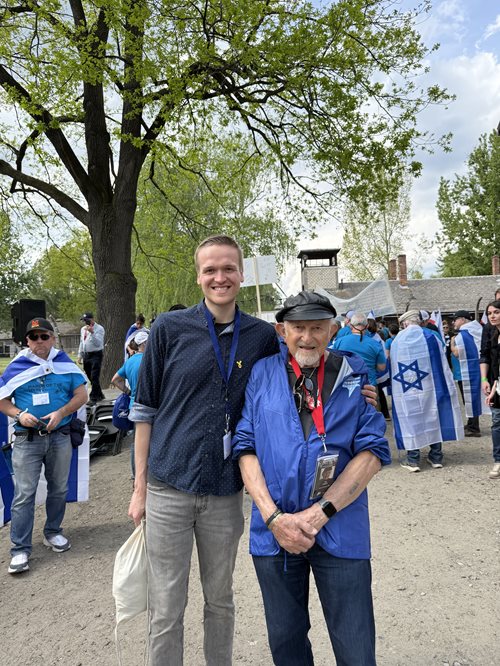
But Nate stopped me. “Of course,” he said, “Rainy River! Decades ago, I worked in engineering on the hospital there – as well as hospitals in Atikokan, Sioux Lookout and Fort Frances.”
It struck me immediately – that last one is the hospital where I was born. The hospital where, just a few months prior, my firstborn son Henry was born as well.
And it took coming all the way to Poland – standing near the “Arbeit Macht Frei” gate so inseparably associated with horror, cruelty and death – to discover how directly this man’s survival had impacted my own life, including the new life of my son. And what a privilege it was to share that connection with him and – through tears – to thank him. (You can read more about his story and our encounter at CTVNews.ca)
Nate graciously signed the copy of his memoir that I had with me in my backpack, and from that unexpected encounter, plans were set in motion for a return to this region in which he had worked as an engineer in the decades before. Bookings were made, posters were printed, and citizens and churches throughout the Rainy River District (and beyond) joined together in raising more than $5,000 to help cover the expenses of a speaking tour. (Donations were collected through GoFundMe.com. Flights and some additional costs were graciously covered by the Friends of Simon Wiesenthal Center.)
Then one year ago (in October of 2025) Nate, his daughter Arla and Simon (a representative from the Friends of Simon Wiesenthal Center) traveled by plane from Toronto to Thunder Bay, and then by car the remaining four hours from Thunder Bay to Fort Frances. And what came next was truly extraordinary.
Most notable was the event held at the Townshend Theatre in Fort Frances on Tuesday, October 21, with more than 500 people in attendance – some even turned away because there was simply no more room (even in the aisles). Titled Bearing Witness, the event began with Simon providing historical context, after which Nate shared his testimony in conversation with his daughter (Nate’s portion of the evening can be viewed on YouTube). One particularly meaningful moment was when I asked how many of those in attendance were also born in the hospital Nate helped design, and dozens of hands shot up, making explicit just how close to (our) home his life and testimony are.
The following morning (October 22), Nate spoke to the students at Fort Frances High School, each of them receiving a personal copy of his memoir due to the generosity of the Azrieli Foundation’s Holocaust Survivor Memoirs Program. And that afternoon, Nate returned to the hospital on which he had worked, taking particular joy in a tour of its electrical components. This also included a visit to the room where both I and my son were born – a room Nate again confirmed he was responsible for designing – after which the day concluded by meeting with the mayor of Fort Frances and having dinner with my family in Rainy River.
Finally, on October 23, more than one hundred K-12 students at Cornerstone Christian School in Emo gathered to hear Nate’s testimony in an age-appropriate way, receiving a personal link to the Holocaust that will endure beyond many of our lifetimes. Though some of them may not yet fully grasp its significance, I am confident they will in years to come, able to share with generations who will not receive this same chance of direct and firsthand witness.
Looking back now one year after these events unfolded, I remain overwhelmed with gratitude – for the remarkable encounter that brought Nate and I together, for the hard work and generosity of many from disparate backgrounds who worked together to make this possible, for the weighty privilege that hundreds of people in this small corner of the world received of bearing witness to Nate’s story, and for Nate himself.
Because of Nate’s strength, those here in the Rainy River District now carry his testimony as both an inheritance and responsibility. Because of Nate’s courage, my son will grow up knowing not only the horrors of Auschwitz but the story of this man who survived it and played a role directly in his life. Because of Nate’s resilience, my own life has been forever changed.
But above all else, I am grateful to God, whose sovereign fingerprints can be seen in every aspect of what took place. Only He could write this story – a story I pray is significant not just because it is remarkable, but also because it is purposeful. Purposeful in its challenge to each one of us that we not to be among the silent, but rather bold in confronting antisemitism wherever it is found. And purposeful in helping in some small way to change the perception of Christians – and of our Jewish Saviour – among our Jewish neighbours.
Ben Mast lives in Rainy River, Ont., with his wife Ireland, son Henry, and son-on-the-way Seth. He pastors at the Rainy River ECC, teaches part-time at Cornerstone Christian School, and is also a 2026-2027 Religious Freedom Fellow at The Democracy Fund.