How a super-committed small group in Langley, B.C., grew together in mentorship and discipleship.
After several rough years during the pandemic (I almost died three times and was hospitalized for five weeks in total), I felt called by God to prioritize a mentoring and discipleship group for young men to encourage them to think and live differently.
All of us have too many recent examples of Christian leaders and friends or former church community members we once admired who have failed to live out courageous, loving, committed lives of discipleship. I wanted to break that trend if it was my last effort on this earth.
I started by soliciting all the men in the church with an email like this:
I have felt strongly from the LORD that I am to mentor, disciple, and pour into a handful of approximately 5 or so of you who are hungry to receive what I have learned in the several decades of my journeying with Christ.
The conditions are that you have to be hungry, willing to learn deeply, able to make every meeting and committed to doing your part because there will be some reading and assignments.
I look forward to hearing back from some of you for whom this rings true in your heart. I think you will know who you are.
Thank you for privileging me with the opportunity to share this journey with you.
My email provoked responses from several men at The River Fellowship (the church I pastor with my wife Heidi). Six were ready to begin, and five stayed through to the end. Some came from stable family backgrounds, others from broken ones. More than half had done graduate studies or moved into them shortly after. Some were athletes with Canadian titles. A few had lived lurid pasts of drugs and sexual promiscuity.
Becoming a contemporary disciple
Could we learn together how to be faithful disciples in the “digital Babylon” of our world? The term is one that Barna Group CEO David Kinnaman uses in his discipleship primer, Growing Together (2022; see also their more recent Discipleship in Community, 2024).
For two years we read together, memorized Scripture and gathered in person every second week for three or four hours – all for the purpose of becoming transformed together by the renewing of our minds, as epitomized in one of our key memory passages, Romans 12:1-2.
It was something like an MA graduate seminar – a fair amount of work for all of us, but a lot of fun as well. I made it clear from the beginning that this was unlike a typical church group but more like a university course, where thoughtful engagement and thorough attention to the readings and other tasks were non-negotiable expectations.
But, of course, that did not preclude us from extracurriculars like chilling together outdoors at the Pacific Ocean with a portable fire pit, sharing several meals together (including the occasional Vancouver smash burger run), and celebrating the marital engagements (and eventual weddings) of a couple of the guys. It was what the Navigators call “Life-to-Life” discipleship.
.jpg?width=500&height=375 "Z7OiXikQ-(1).jpg") Once the effectiveness of this group and mode of discipleship became apparent in our church body, we started a regular, separate and larger group called Dove Central for anyone else who wanted to attend (similar in structure and content, but less onerous on the preparatory expectations).
Once the effectiveness of this group and mode of discipleship became apparent in our church body, we started a regular, separate and larger group called Dove Central for anyone else who wanted to attend (similar in structure and content, but less onerous on the preparatory expectations).
We eventually called the 5 guys mentoring group Mend, based on a concept in Judaism called tikkun olam, which refers to repairing or mending the world as a response to the gift of life. The four-letter name also reminded us of Mentoring and Discipleship.
My sensed objective for my 5 guys was to “teach them everything I knew,” accompanied by an urgent call to cultivate committed followers of Jesus Christ, meaning ones who mimic Jesus their Lord and engage a transformation that erases any dualism between spirituality and its concrete embodiment through the gospel of the Kingdom. To embody integrated lives that release the wholeness of shalom into this world in a reparatory, redemptive way.
Bonhoeffer put it this way in The Cost of Discipleship: “When Christ calls a [person] he bids him come and die.” The resurrection life is possible only when prefaced by a crucified life.
Simone Weil’s more philosophical musings on this theme in her collection of notebook thoughts, published as Gravity & Grace in 1952, remain instructive as well: "Affliction which forces us to attach ourselves to the most wretched objects exposes in all its misery the true character of attachment. In this way the necessity for detachment is made more obvious. Attachment is a manufacturer of illusions and whoever wants reality ought to be detached" (page 59).
One of my athletic guys (now a seminary student preparing for pastoral ministry) described the effects of Mend on his personal discipleship as follows:
The most powerful truth I learned from all of our time together was that God is my Father and through Christ I am His beloved son (the books Experiencing Father's Embrace and The Return of the Prodigal Son had the most profound impact on my understanding of this truth). Living out of this paradigm of being beloved has affected my perspective on every aspect of life. It is like putting on a different lens to view reality, a lens that was lacking in my life before Dove Central and Mend.
Learning as discipleship
One of the first things I taught was that the New Testament Greek word for “disciple” (mathētēs) means “learner,” so learning with a keen mind and a requisite humble heart constituted a holy pursuit before the LORD.
In fact, the posture of humility as a cardinal virtue was something I constantly highlighted, and also that this discipleship learning must not be relegated strictly to the cognitive domain.
One of my life verses challenges me constantly to be a lifelong learner and I passed this on to the boys in our very first meeting: “For Ezra had devoted himself to the study and observance of the Law [instruction] of the LORD, and to teaching its decrees and laws in Israel” (Ezra 7:10).
This is not necessarily a strict formula with inflexible rigidity, but definitely incorporating study (a seeking mode of inquiry), observance (the practice of doing) and then teaching (diligent, skilful training) as non-negotiable ingredients to the process of holistic learning.
Many years ago, Thomas Merton wrote,
A purely mental life may be destructive if it leads us to substitute thought for life and ideas for actions. The activity proper to man is not purely mental because man is not just a disembodied mind. Our destiny is to live out what we think, because unless we live what we know, we do not even know it. It is only by making our knowledge part of ourselves, through action, that we enter into the reality that is signified by our concepts (Thoughts in Solitude, page 16).
So I emphasized prominent features of Jesus-centred Kingdom discipleship that I considered essential in areas like Identity, Authority, Leadership, Worship, Spiritual Gifts and Spiritual Warfare, which I unpacked and accompanied with critical core values I have come to embrace. I also shared less useful past modes to avoid that I have chosen personally to discard – the unlearning part of discipleship, for example, living under obligation with a shame-based identity.
Foundational virtues for discipleship
Some of the core values I expressed to my guys were honesty, integrity, character and a personal self-image encompassed by resting securely in our spiritual-sonship over and above a performance-based identity.
All of this assumed the truth of the Bible as the locus of ultimate authority, pried open with an exegetically-based biblical theology for their normative discipleship journey – at least as a starting point for biblical hermeneutical exploration.
From there we could move into more contemplative interpretive modes like Lectio Divina, in the same way that a true visual artist must know basic principles of drawing before they can convincingly cross over into abstract expressionism and not look like a complete novice.
Our initial reading assignment of H. G. Wells’ timeless classic, The Country of the Blind (1911), about a sighted mountaineer who accidentally lands in a generations-old blind community that considers sight a defect, served well to introduce my core-value concerns for them not to buy into any false consciousness or allow any duality between thought (or theology) and action. Theology leads to doxology which does not bifurcate from holy praxis. To serve the other, and to love, in humility.
At the risk of our little group becoming elitist or drifting into superiority because of our privileged learning times together, I admonished them with the reality that just because you have read all these books, it does not mean you are all integrated with it into your life.
This challenge is articulated well by German theologian Helmut Thielicke in A Little Exercise for Young Theologians, where he wrote,
Truth seduces us very easily into a kind of joy of possession: I have comprehended this and that, learned it, understood it. Knowledge is power. I am therefore more than the other man who does not know this and that. I have greater possibilities and also greater temptations. Anyone who deals with truth—as we theologians certainly do—succumbs all too easily to the psychology of the possessor. But love is the opposite of the will to possess. It is self-giving. It boasteth not itself, but humbleth itself (pages 37-38).
Thielicke refers to this reflective detachment and the conflict between truth and love as “precisely the disease of theologians” (page 39). Duly noted, from a professor of systematic theology who was dismissed from his academic post in Heidelberg in 1940 because of opposition to the Nazi regime.
Basic discipleship practices
Our Mend group memorized 23 verses and read 10 books together, usually preparing one or two chapters per session to absorb material most effectively and to be able to discuss it well. During our fortnightly meetings, we reviewed our memorized Scripture, worshiped together, engaged in contemplative soaking prayer, laid hands on one another in intercession and blessing, and shared prophetic words and pictures to build up, fortify and encourage each other.
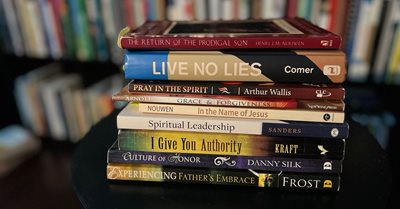 One sharp young entrepreneur, thinking about the results of his experience, told me, “Scripture memory is now a regular part of my devotional process.” Mission accomplished, in my books.
In fact, participants in both Mend and the larger Dove Central group reflected deeper understanding in matters of the heart, resulting in greater buy-in and increased involvement in service through the discovery and use of their particular gifts.
If these experiments are adapted in other contexts, my key advice would be to pray, settle on a set of core values and invite a small enough group to read and discuss relevant books together, memorize powerful Scriptures and then watch and see what happens.
Paul Edward Hughes has a PhD in Hebrew and Old Testament studies from the University of Edinburgh and taught biblical studies at Trinity Western University for just under 12 years before planting a church called The River Fellowship in Langley, B.C., with his wife Heidi, which they have co-pastored for almost 19 years. Photos by Paul Edward Hughes. Download a PDF of the memorized verses and books read.